Interactive Digital Twin Hub

Design a Cooler, Greener and Energy Efficient Neighbourhood

A neighbourhood-scale digital twin to test interventions before spending millions

Heat risk
Energy poverty
Retrofit complexity

Current Twekkelerveld Condition

UHI peak (°C)
0
NDVI
0
Annual demand (MWh)
0
PV potential (MWh)
0
CO₂ (kt/yr)
0
Vulnerable HH (%)
0
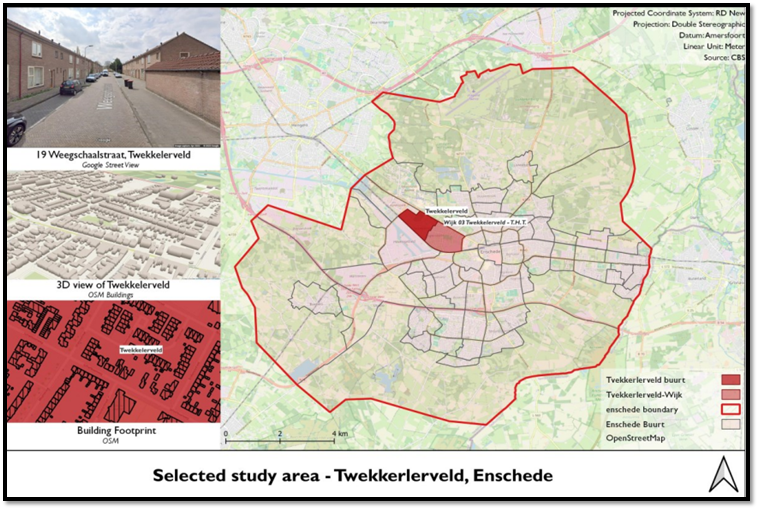
Twekkelerveld Map

Why Twekkelerveld?

  • Mixed building stock → retrofit tradeoffs are real.
  • Heat + energy affordability collide here.
  • Perfect scale: neighbourhood interventions actually measurable.

Neighbourhood Hotspots

Location details

Learn from international examples on cooling, energy, retrofits and community solar.

Now
Hotter summers, rising bills.
2027
Grid pressure + retrofit targets.
2030
Policy deadlines (EU targets).
2050
Climate baseline shift.

Predefined Scenarios

Urban heat reduction
Reduce energy bills
2050 heat stress test

Current Digital Twin Situation

Location details

Ecology Digital Twin • Twekkelerveld Sources: Landsat 9 · BGT · AHN · KNMI
Energy Digital Twin • Twekkelerveld Sources: Enexis · Zonnedakje · BAG · CO₂ factors
Combined Scenario Analysis
Simulate integrated energy and ecology measures to maximise co‑benefits. Balance space and investment budgets while exploring greenness, heat, energy use, CO₂ and cost.
Scenario settings
Additional trees
0 trees
Trees sequester ~20kg CO₂ per year and cost ~€350 each.
Extra rooftop PV
+0% PV capacity
Relative to current PV potential. Cost ~€5,400 per +1%.
Insulated buildings
0% of stock
Approx. 25–30% energy savings at 80% stock insulated.
Heatwave severity
Level 0
0 = normal summer, 3 = extreme heatwave.
Green roof coverage
0% of roofs
Vegetated roofs insulate buildings and provide shade.
Budget
0
Maximum investment budget to optimize scenario.
Space budget
100% space
Maximum share of available space that can be used for trees and green roofs.
Baseline metrics: NDVI ~0.22, UHI ~9°C, energy ~5GWh. Adjust sliders to see impacts.
NDVI (base)
0.22
UHI (base)
9 °C
Energy
5,000 MWh
PV Pot.
650 MWh
CO₂
1.8 kt
Trees
2,400
Greenness (NDVI)
Base ~0.22
Urban heat (°C)
Base ~9 °C
Energy & PV
MWh/yr
Overall balance
Score
Stakeholder benefits
Score
Residents
  • Cooler summers and improved health through more trees and green roofs
  • Lower utility bills thanks to rooftop solar and deep retrofits
City planners
  • Progress towards climate targets with lower CO₂ emissions
  • Greater resilience and social equity for the neighbourhood
Cost & Space vs Benefits
Scenario
Greener
+0%
Cooler (UHI)
-0.0 °C
Energy demand
-0%
CO₂ balance
-0%
Total cost
€0
Protected HH
0%
Space used
0%
Cost–benefit calculation explained

Cost–benefit scores allow you to compare different aspects of the scenario on a common 0–100 scale. The total project cost is divided by your selected budget and multiplied by 100. Space use is normalised in the same way against the available space budget. The benefit score is the arithmetic mean of greenness, cooling, energy savings, CO₂ reduction and a health score. Normalisation aligns values with different units to a common range and is typically applied before averaging.

The health score draws on evidence linking green space and well‑being. A scoping review found that a 25 % increase in neighbourhood tree canopy was associated with a one‑point decrease on the 5‑point Depression Anxiety and Stress Scales (DASS). Another study reported that spending 10–50 minutes in natural spaces improved mood, focus and physiological markers like blood pressure and heart rate. Both trees and green roofs therefore contribute to the health benefits shown in this dashboard.

For formal definitions of net present value (NPV) and benefit–cost ratio (BCR), and other underlying formulas, see the Equations & assumptions section below.

Sources: Wikipedia – Normalization (statistics); Urban Trees & Human Health; Spending time in nature reduces stress.

Equations & assumptions

Energy cost: (gas consumption × pricegas) + (imported electricity × priceelec) − (exported electricity × feed‑in tariff).

CO₂ savings: (baseline energy − new energy) × emission factor.

Benefit–cost analysis: Net present value (NPV) = Σ (cash flow ÷ (1 + discount rate)year) − capital cost; Benefit–cost ratio (BCR) = NPV of benefits ÷ NPV of costs.

Tree carbon sequestration: Each additional tree is assumed to absorb ~10 kg of CO₂ per year and provides shade and cooling benefits.

Green roofs & vegetation: Vegetation and green roofs help cool buildings and neighborhoods by shading surfaces, deflecting solar radiation and releasing moisture.

PV costs: High‑efficiency PV modules are about €0.115 per Wp; the slider's default of €5,400 per +1 % PV capacity is based on typical installed costs.

Default parameter values: Tree cost €350 per tree; PV cost €5,400 per +1 % capacity; retrofit cost €12,000 per dwelling; green roof cost €8,000 per +10 % roof coverage.

Health benefits: Exposure to trees and green spaces is linked to better mental and physical health. A scoping review reported that a 25 % increase in neighbourhood tree canopy correlated with a one‑point decrease on the 5‑point Depression Anxiety and Stress Scales (DASS) [study]. Researchers at Cornell University found that spending 10–50 minutes in natural spaces improved mood, focus and physiological markers like blood pressure and heart rate [study]. The health score used in this dashboard assumes that both additional trees and green roofs contribute equally to these wellness benefits.

These formulas and assumptions show how ecological (trees, green roofs) and energy (PV, retrofits) interventions interact. More trees and green roofs increase greenness and reduce urban heat, while PV and insulation reduce energy use and emissions. The combined scenario score weighs these co‑benefits against investment and space budgets over your selected time horizon.

Sources: Investopedia – NPV formula; Investopedia – BCR; One Tree Planted – tree CO₂ absorption; US EPA – heat‑island benefits of vegetation; Rinnovabili – PV module prices.

Energy & Economic Settings

Prices (€/unit)

Costs

CO₂ factors (kg CO₂ per unit)

CBA parameters

Budget cap

Show equations & assumptions

Energy cost: (gas × pricegas) + (imported electricity × priceelec) − (exported electricity × feed‑in tariff)

CO₂ savings: (baseline energy − new energy) × emission factor

Cost assumptions: PV cost per Wp (costs.pvPerWp), insulation per m² (costs.insulationSqM), heat pump costs (costs.hybridPump/allElectric)

NPV:t=1T (Annual savings)/(1 + r)t − Capex

BCR: Present value of benefits ÷ Capex

Defaults: values drawn from the PARAMS object (units as indicated)

Ecology & MCDA Settings

Weights (0–1)

Costs

CBA parameters

Feasible space limits

Show equations & assumptions

Tree carbon sequestering: ~20 kg CO₂/year/tree; benefits include shade and amenity.

Green roof: Provides insulation and reduces runoff; cost per m² specified above.

Infiltration strip: A vegetated zone along creeks to retain stormwater and cool the microclimate.

NPV:t=1T (Annual benefits)/(1 + r)t − Capex.

BCR: Present value of benefits ÷ Capex.

Stakeholders & users

Stakeholders: residents, local businesses, schools, NGOs, municipality, utilities.

Users: municipal planners, sustainability officers, housing association asset managers, consultants/researchers.

User stories:

  • Municipal planner compares scenarios under a €X budget.
  • Housing corporation prioritizes buildings for retrofit & PV.
  • Community group explores greening options and trade‑offs.
  • Researcher studies the trade‑off between carbon and heat mitigation.

Assumptions & Settings

Financial & Scenario Parameters

Unit Costs

Limits

MCDA Weights

Transparency: Equations

Scenario metrics are computed using simplified relationships based on published literature. For example, UHI reduction per tree is approximated as 0.1 °C per 300 trees and green roof cooling as 1 °C per 100% roof coverage. These parameters can be updated in the code.

Transparency: Data sources & ranges

Default cost values originate from studies of urban greening and energy retrofits. Allowed input ranges ensure realism (e.g., green roof coverage up to 100%, discount rate between 0–10%).